Blog
A Foreign Game Studio's Journey into Turkey: From the First Email to the First Dividend
Relocating an 80-person Latvian game studio to Turkey: the A.Ş. decision, Technopark regime, 100% service-export deduction, transfer pricing.
From the first email to the first dividend — a map read along the time axis.
We began the meetings with a Latvia-based mobile game studio for setting up their Turkish operation. An 80-person team; live titles on the App Store and Google Play; a clear intent to move into Turkey. There was no single question on the first table — but every question pointed at the same heading: who runs this process, how, and over what timeline?
If you can answer that in thirty minutes, you are not a good advisor. The same question, in under an hour, fans out into pages of sub-questions, a four-month execution path, and a five-year plan. “Setting up an operation in Turkey” is not a single step; it is a map of interdependent decisions arranged on a timeline.
This piece is the written form of that map. It follows the spine of the process by which we placed this Latvian studio on the ground in Turkey. The name is anonymized; the process is real.
In 60 Seconds (TL;DR)
TL;DR — 60 seconds
80-person Latvian mobile game studio’s Turkey journey: A.Ş. formation (not Ltd. — required for stock options), Technopark regime (100% CIT exemption), service-export exemption (App Store/Google Play → Ireland-resident payment = export), TNMM transfer pricing.
3 risks: GVK Art. 17 vesting 3-year recapture, foreign-corporate bank account 4-8 weeks, Pillar Two QDMTT for EUR 750M+ groups.
First question: Is group revenue below EUR 750M? If so, Turkey’s package is structurally optimal.
A Latvia-headquartered 80-person mobile game studio’s Turkey deployment took four months. Decision: Joint-Stock Company (A.Ş.). Reason: investor-round readiness, share-transfer flexibility, and the GVK Art. 17 employee-stock exemption. The Technopark regime provided 0% corporate tax on software income; CTL 32/C minimum corporate tax introduced a 10% floor from Year 4. On payroll, the 2026 meal-allowance reform (Law No. 7577) saved roughly TRY 1,034,669 in annual SGK contributions for an 80-person team. The real value: sequencing structural decisions, preparing the bank KYC + UBO file in advance, and engineering the tax architecture from day one. Anticipating field-level friction points — that is the actual deliverable of twenty years of practice.
Topology — The Structure at a Glance
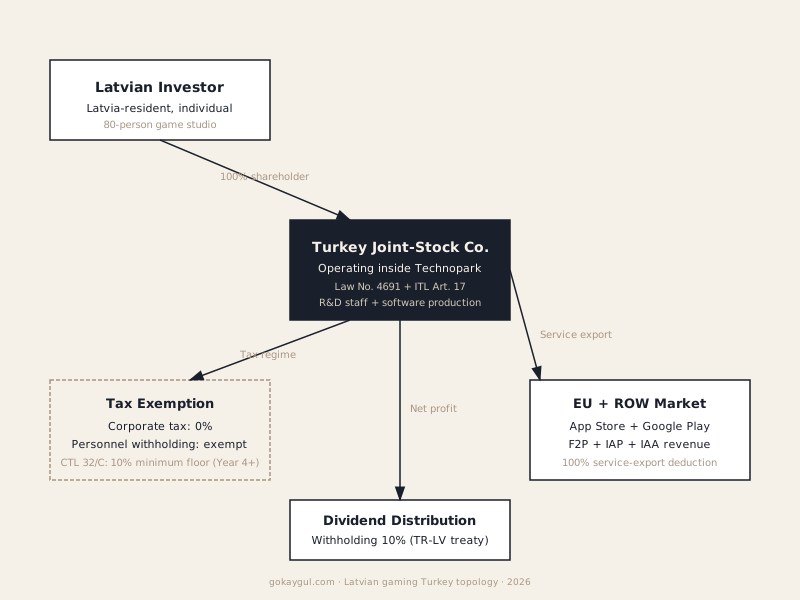
Visual reading: A wholly owned Turkish JSC operates inside Technopark for R&D and software production; corporate tax exemption and personnel withholding tax relief apply; service is exported to EU market; profit is distributed to the Latvian shareholder at the 10% withholding rate under the bilateral tax treaty.
Month 0 — Intent and Structural Choice
The Latvian studio had already made part of its decision intuitively before walking in. The real reason they were moving to Turkey was never a single tax article; it was a package:
- The corporate-income-tax exemption that the technology development zone regime grants on qualifying software income,
- The income-tax withholding exemption and the social-security premium support for R&D personnel,
- The ability to bring overseas marketing spend under Turkish government export-support programs through a Turkey-based structure,
- And as of 2026, the 100% corporate income deduction on software and digital-game services provided to non-resident clients.
And underneath all of that: the Turkish game-developer talent pool is both broader and structurally different in cost terms compared with Latvia. Moving the operation to Turkey was not a technical decision; it was an economic one.
The first question on the table consolidated into a single line: which structure do we come in with?
The answer became clear quickly: a Joint-Stock Company (A.Ş.). Three reasons, each pointing at the future:
- Investor optionality. Within five years the studio could realistically raise additional capital, strike a strategic partnership, or open exit/sale conversations. Share transfer in an A.Ş. is frictionless; in an Ltd. it requires notarization, share-ledger entries, and trade-registry filings. Institutional investors have a clear view of which structure they expect.
- Flexibility in shareholder count. The A.Ş. accommodates a flexible shareholder base; the Ltd. enters a fresh bureaucratic cycle on every share movement.
- Tax position. Capital gains on the sale of A.Ş. shares can sit in a favorable position when the required securities (share certificates / temporary share documents) have been issued and the holding-period condition is met. The same mechanism cannot be set up in an Ltd.
In addition, the share-based wage exemption (Income Tax Act Art. 17) — a critical retention tool for keeping qualified technical staff inside the studio — is only available within the A.Ş. structure; Ltd. companies cannot issue share certificates, so they cannot use this retention instrument. Yet the exemption hides a holding-period risk: if the employee sells within 3 years, 100% of the exempted tax is clawed back; within 4–6 years, 75%; within 7–12 years, 25% — collected from the employer with default interest. In a sector with high personnel turnover like games, a full 12-year holding shield is unrealistic; an option plan therefore requires the studio to book a provision and to write the vesting schedule tightly into the contractual frame.
| Criterion | Joint-Stock (A.Ş.) | Limited (Ltd.) |
|---|---|---|
| Minimum Capital | TRY 250,000 | TRY 50,000 |
| Share Transfer | Flexible, no notary needed | Notary + share ledger + trade-registry filing |
| Fit for an Investment Round | High — VC/PE standard | Low |
| Employee Share Plans (ITA Art. 17) | Available | Not available |
| Fit for Acquisition | High — buyer-side default | Conversion required first |
| Tax on Share Sale | Exemption door open under conditions | No exemption door |
The decision was made. The articles of association were not drafted with off-the-shelf language; they were written with provisions specific to game-studio activities — software development, digital product sales, licensing, royalties management — that would not later raise friction in a service-export claim or a Technopark application.
The First Six Weeks — Formation and the Banking Wall
After the decision, speed.
Registering the foreign corporate shareholder inside the Turkish system, filing on MERSİS, and registering the articles of association were completed quickly. In parallel ran another flow: travel plans of the shareholders, notary appointments, and the careful scoping of the powers of attorney. The invisible work is the real work. If a power of attorney is written too narrowly, the investor flies back to Istanbul for every document; written too broadly, the banks reject it. Finding the right midpoint is an experience matter.
The Latvian studio’s officers came to Turkey only once during the entire process — for the in-person signature required at the bank-account opening. Everything else was handled in Turkey through powers of attorney. For the investor, this is the difference between seven or eight separate trips and a single flight.
Then came the real friction zone: the bank.
Opening an account in Turkey for a company with a foreign corporate shareholder is the most concrete place where the country’s lack of bureaucratic standardization makes itself felt. The same document file gets a different reaction depending on the bank, the branch, even the relationship manager. In our case the process closed quickly. The reason was structural preparation: KYC and UBO (Ultimate Beneficial Owner) files were assembled in advance, the account architecture (TRY + EUR + USD) was planned from the start, and the right commercial segment — one with experience in foreign-capital structures — was chosen. The first documented FX inflow on the bank side simultaneously laid the legal ground for any future dividend remittance.
Incentives, Marketing Refunds, and Operational Build-Out
Company and bank, done. The next layer: anchoring the incentive architecture.
One of the studio’s core motivations was entry into the Technopark regime. This is not a routine registration; it requires a location decision, team structuring, a lease agreement, and a long application file. Software income earned inside the Technopark enjoys the corporate-income-tax exemption — but if the revenue architecture is not set up correctly from day one, certain revenue types fall outside the exemption. In particular, the tax distinction between ad revenue (IAA) and in-app purchase revenue (IAP) for free-to-play game studios is a critical line item that must be clarified at the start. Changing this distinction later is expensive.
Alongside this, the Ministry of Trade’s support programs for the software and digital-game sector were activated. With the new Service Sectors Breakthrough Program effective February 2026 — the software-personnel employment subsidy was abolished, but the program critical to game studios, the rebate for foreign digital-advertising spend, was preserved with an annual cap of TRY 50 million. User acquisition is the largest cost line for a mobile game studio; it can reach six-figure USD levels per month. A significant portion of ad spend on Google, Apple Search Ads, Meta, and similar platforms is refunded by the government within product- and annual caps. In the same way, commissions paid to App Store, Google Play, and Steam are supported under a separate annual ceiling of TRY 20 million. With proper application discipline, this mechanism is a direct lever on annual profitability.
On payroll, 2026 produced a two-sided ledger. On one side, Law no. 7566 raised the SGK contribution ceiling from 7.5× to 9× the minimum wage, lifting the monthly social-security premium burden on ceiling-level staff — senior engineers, art directors — by roughly 61.7% to TRY 103,301. The reduction of the 5-point Treasury premium discount to 2 points in non-manufacturing sectors further increased employer cost. On the other side, Law no. 7577, effective April 2026, raised the daily SGK exemption for cash meal allowances from TRY 158 to TRY 300, aligning it with the income-tax exemption. A case-specific calculation: for an 80-person team offering TRY 300/day in cash meal allowance (22 working days/month), the new framework produced approximately TRY 1,034,669 in annual net SGK premium savings. When payroll architecture is built correctly from day one, savings at this magnitude can absorb a meaningful share of the new ceiling load on senior staff.
The Latvian studio was wholly unfamiliar with Turkey’s tax and accounting system. To close that gap, all of the company’s statutory responsibilities, tax-return cycles, annual reporting calendars, and incentive-application workflows were walked through step by step. Behind-the-scenes but critical items — such as the annual investment declaration every foreign-capital company is required to file — were placed onto the corporate calendar. The operation became a calendar discipline.
End of Year One — The First Full Set of Books
Year one’s hidden exam is transfer pricing. Every transaction with the foreign parent — management services, IP / royalties, shared-cost allocation, financing — must be priced on an arm’s-length basis. The most common structure in games is a hybrid of license and cost-plus: the Turkish studio handles development, the parent holds the IP. Built correctly, it stands up under audit; built incorrectly, it generates a retroactive assessment three years later. Annual mandatory documentation, return annexes, and benchmarking files have to be planned in from the start.
With Presidential Decree no. 11257 dated 30 April 2026, the deduction rate under Article 10/1-(g) of the Corporate Income Tax Act on software and digital-game services delivered to non-resident clients was raised from 80% to 100%. Combined with the 5-point export discount (25% → 20%), the effective corporate-income-tax burden on qualifying export earnings can theoretically reach zero — provided two strict conditions are met: the full service consideration must be brought into Turkey by the tax-return deadline, and a sworn financial advisor (YMM) certification report must be prepared for exempted amounts above TRY 500,000. If even 1% of the consideration is left abroad, the deduction is not pro-rated — it is lost entirely.
Against this, also effective in 2026, the domestic minimum corporate income tax (CIT Art. 32/C) rule sets a floor: the Technopark exemption cannot be subtracted from the minimum tax base. From year four onward, the studio’s cash flow must therefore account for a 10% floor tax obligation. Additionally, companies whose annual Technopark exemption exceeds TRY 2 million carry an obligation to transfer 3% of the exempted earnings as an investment into venture-capital funds or incubator firms, which enters the operational calendar as a recurring item.
A VAT-refund mechanism may operate on App Store and Google Play revenues — but the right depends on the application’s target-market structure. For a title aimed exclusively at non-Turkish users, the right is cleanly grounded; if the title is also accessible to Turkish users, the scope of the right narrows. The studio’s revenue architecture must account for this nuance at the design stage.
At the dividend distribution and parent-remittance stage, when Turkey’s double-taxation treaty with the investor’s home country is applied with the right documents (tax-residence certificate first), the reduced withholding rate applies. The documents the bank will ask for — the tax-return copy, the withholding receipt, the board resolution, the FX-purchase certificate from the initial capital inflow — were prepared in advance, removing weeks of waiting.
Three Regrets We See on the Ground
We have been working with foreign-capital firms for years. Looking back, the three- to five-year “I wish I had known” headlines collapse into three themes.
One: the lack of bureaucratic standardization. One institution gives you one answer; a different branch of the same institution gives a different answer for the same document. Two officers within the same branch can read the same file differently. The rule is not unclear; the consistency of application is unclear. Investors underestimate this friction at the start. Three years later, looking back, they see that most of their lost time and money came from the same file being read differently in different places.
Two: work-permit tempo varies with security clearance. Game studios want to bring part of their technical team into the country. The first-two-foreign-personnel exemption granted to the IT sector smooths the legal path — but the actual duration of the security clearance varies materially with the candidate’s country background. EU and OECD citizen applications typically clear in six to eight weeks; for certain origin countries, the process can stretch toward six months. For an investor trying to time the operation, that gap creates both interim-staffing cost and waiting cost on the overseas team.
Three: the layered complexity of the tax and incentive system. The Turkish tax system is not a single tax. VAT, corporate income tax, minimum corporate income tax, withholding, stamp duty, non-deductible expenses — each carries its own logic. Multiple tax layers can stack on the same transaction. And the layers don’t work in isolation: using one incentive triggers another obligation; benefiting from a deduction opens a new reporting calendar; exceeding certain incentive thresholds brings on additional items like annual fund-transfer requirements. The most common surprise for a foreign investor is a third- or fourth-year assessment or a retroactive obligation notice. The regret is not about ignorance; it is that the initial books and obligation structure did not sense these layers.
Our Approach: One Front Door, Many Institutions Managed Behind It
From the moment a company is formed in Turkey, it exchanges data and documents with at least 12–15 institutions: Tax Offices, the SGK, Trade Registry Directorates, MASAK, the Central Bank, the Presidency’s Investment Office, the Migration Directorate, the Ministry of Labor and Social Security, the Ministry of Industry and Technology, the Ministry of Trade, the Revenue Administration’s e-infrastructure (e-invoice, e-ledger, e-archive), the Public Oversight Board, KVKK, Customs, municipalities. Game-sector-specific: the Technopark management offices, the Ministry of Culture and Tourism’s copyright-work registration processes, the Service Exporters’ Association membership, the KOSGEB and TÜBİTAK support programs, App Store and Google Play platform reporting. None of these institutions knows how the others operate.
This is where our value proposition becomes specific: a single point of contact for the investor. We know which institution wants what, in which format, by which deadline.
Our actual contribution is anticipating the flow frictions that are written down nowhere. Twenty years of accumulated experience is the map of this terrain. If the Latvian studio’s process ran on schedule, the reason is not only command of the regulation; it is that the surprise points along the flow had already been marked in advance.
Closing
Investment is shaped not by the tax rate, but by time. The true variable in an investor’s hand is not capital; it is the calendar. The decisions made early draw the ceiling on the size the operation will reach five years later.
The Latvian studio understood this quickly. Today the operation in Istanbul runs on its own rhythm, and the team is focused only on building games. The Turkish entity functions as a smooth extension of the Latvia-based structure.
Our role is to stand in the same position at every stage of that journey: one point of contact, one interpreter, one operational partner. If you would like to spend your energy on global growth rather than on paperwork while shaping your entry strategy into Turkey, this is the architecture we can build together.
Frequently Asked Questions
Should a foreign-capital game studio set up a JSC or LLC in Turkey?
A Joint-Stock Company (A.Ş.) is the correct choice when investor rounds, exits, or share-transfer flexibility are anticipated. Minimum capital is TRY 250,000, share transfers do not require notarisation, and the GVK Art. 17 employee-stock exemption is available. This mechanism cannot be built into an LLC.
How does the Technopark regime apply to software revenue?
Under Law No. 4691, software income is exempt from corporate tax. However, if revenue architecture is not properly structured from day one, certain revenue lines (e.g., in-app advertising vs in-app purchases) may fall outside the exemption.
Does the CTL 32/C domestic minimum corporate tax erode the Technopark exemption?
Yes — the 10% domestic minimum CIT introduced in 2026 cannot be offset against the Technopark exemption. From Year 4, a 10% floor must be factored into cash-flow planning.
How long does it take to open a Turkish bank account for a foreign-parented company?
One to two weeks if documents are ready. Pre-prepared KYC + UBO files and the right commercial segment selection accelerate the process; otherwise it can take months.
What is the hidden risk in the GVK Art. 17 employee-stock exemption?
If the employee sells the exempted share within 3 years, 100% of the exempted tax is recovered from the employer with default interest; within 4-6 years, 75%; within 7-12 years, 25%. Given the high turnover typical in the game sector, ESOP plans must include a provision and a strict vesting schedule.
What 2026 incentives does the Ministry of Trade offer to the digital-games sector?
Under the Service Sectors Leap Programme, foreign digital advertising spend is reimbursed up to TRY 50 million per year. App Store, Google Play and Steam commissions are reimbursed under a separate TRY 20 million annual cap.
How does the 2026 SGK ceiling change affect the studio?
Law No. 7566 raised the contribution ceiling from 7.5× to 9× the minimum wage, increasing senior-developer SGK premiums by roughly 61.7% to TRY 103,301/month. The Law No. 7577 meal-allowance reform (TRY 300/day SGK exemption) compensates a significant share of this burden.
How many times does the Latvian investor need to travel to Turkey?
Typically once — for the in-person signature required at bank-account opening. All other steps (MERSIS, Trade Registry, tax office, e-signature) can be completed in Turkey using a properly scoped power of attorney.
Related Reading
- Turkey Technopark 2026 — Law 4691 + Pillar Two + YMM attestation
- Setting Up a Foreign-Capital Company in Turkey — A.Ş. vs Ltd. selection
- Foreign Investor Banking in Türkiye — AML/KYC process
- IFC 2026 and QSC — Group structure alternative
- Service: Technopark Setup & R&D Centre — Process, scope, pricing
- Guide: Foreign Investor Onboarding — End-to-end roadmap